Thursday, January 8, 2009

Book Review: Doc Savage #23: Mystery Under the Sea & The Red Terrors

I first discovered Doc Savage in 1974, through the reprint series presented in paperback by Bantam Books. Doc was the creation of Lester Dent (writing under the house name of Kenneth Robeson), one of the most prolific pulp writers of the 1930s and 40s, and was rivaled only by the mysterious Shadow in sheer popularity. 

A physical and mental marvel, raised from infancy for his task of aiding and serving humanity, Clark Savage Jr., more familiarly known as "Doc," was an unrivaled surgeon and inventor, a perfectly developed physical specimen, an expert in virtually every field of human endeavor, and even a noted concert violinist. With the help of his five aides - Andrew Blodgett "Monk" Mayfair, Theodore Marley "Ham" Brooks, John "Renny" Renwick, William Harper "Johnny" Littlejohn, and Thomas J. "Long Tom" Roberts - Doc traveled the world righting wrongs, helping the oppressed, and punishing the guilty.

More super than Superman, more accomplished than Batman, smarter than Indiana Jones, more dashing than James Bond, Doc served as inspiration for all those iconic characters and more. His adventures were fast-paced and exciting, ranging from lost jungles to the depths of the ocean to the far-flung Polar regions and beyond. Wherever action and adventure presented itself, Doc and his "Fabulous Five" were there. In the days of the Bantam reprints, it was a thrill to anticipate the publication of the next "supersaga," much as it must have been for the original readers during the Great Depression.

Now, modern readers can experience that same sense of excitement, as Sanctum Books (in cooperation with Nostalgia Ventures up until recently), is reissuing these classic tales of adventure, two stories at a time, in attractive trade paperback editions. Edited and spearheaded by Anthony Tollin, each volume contains a pair of Doc adventures, along with commentary by Tollin ( a long-time pulp historian, whose Shadow Scrapbook is required reading for any fan) and historian/author Will Murray that provides valuable insights into the tales presented. 

I've read all of the 182 Doc supersagas presented by Bantam (181 is the official count, but Bantam also published The Red Spider, a novel written by Dent but never released during the official run of the pulps), but I'm enjoying this new series for several reasons. First, of course, is the commentary. Tollin and Murray have access to archives and documents that provide fresh insights into these classic tales, and the information they provide is always worthwhile. Like DVD commentary tracks, these supplemental features provide invaluable information that makes the stories even more entertaining. 

Second, Murray and Doc-fan Scott Cranford have, in many cases, restored material that was edited out of the original versions, creating a sort of "Director's Cut" of the stories he reprints. In the recent volume, for example, nearly 7,000 words of Dent's original text, cut by editor John L. Nanovic's assistant Morris Ogden Jones in order to make room for a supplemental short story, have been restored. That's a fair chunk of original material - most of Dent's Doc novels ran about 60,000 words -  that has never before seen the light of day. Even to a confirmed fan like myself, there's always something new to discover in this wonderful series.

Third is the presentation. Tollin includes copious original illustrations, giving the book the feel of the pulp from which it comes. Many of the volumes sport two covers, a choice of either the original Walter L. Baumhofer cover from the pulp, or the James Bama cover from the Bantam reprints. Either version is a winner.

This latest volume in the Doc Savage series presents Mystery Under the Sea (originally published in February, 1936) and its sequel, The Red Terrors (originally published in September, 1938). Both deal with lost underwater cities and civilizations, and both are filled with the rollicking action that Doc was known for. Although the quality of the Doc novels suffered somewhat during the later part of the run (especially when the full-sized pulp became a digest during World War II and beyond), these two stories are from Doc's prime period, when Dent was at the peak of his writing powers. Everything you could want in a Doc adventure is here: a baffling mystery, a heinous villain, an exotic locale, deathtraps aplenty, solid pacing, and more. Doc's stories rarely had sequels - one could argue that The Devil Ghengis is a sequel to The Fortress of Solitude, as both feature the villainous John Sunlight, the only one of Doc's adversary's ever to make a return appearance - making this volume particularly noteworthy.

Dent devloped an outline, a "master plot," as he called it, that he used throughout most of his career, one that, he said, was guaranteed to result in a sale to an editor.  "The business of building stories," he said, "seems not much different than the building of anything else." If this is true, then Dent was, surely, a master architect, as his stories, like the best buildings, have stood the test of time. The use of this outline is clearly seen in these two stories, as Dent piles exciting event upon exciting event, all driving towards a tremendous climax. Rather than feeling formulaic, however, Dent keeps his stories fresh by presenting his material in new and different ways. Even with two stories as thematically similar as Mystery and Terrors, you never get the feeling he's rehashing old ground or recycling old material. And that, of course, is why Dent was one of the premiere pulp writers of his age. 

If you're a fan of pulp literature, or if you've never heard of Doc but have enjoyed movies like Raiders of the Lost Ark, you owe it to yourself to check out this outstanding reprint series. At $12.95 per volume, this is easily one of the best values around. Tollin and company are also publishing similar reprints of The Shadow - another series I'm following avidly - with other pulp characters in the works for 2009. Available at your local comic or bookshop, these are enthusiastically recommended to anyone who enjoys a good, exciting story.

Tuesday, January 6, 2009

Superstition in the 21st Century

We're fortunate to live in an era of unprecedented technological achievement. From the vastness of outer space - we recently observed a gamma burst from nearly 13 billion light years away - to the mysteries beneath the earth's oceans - we've observed hydrothermal vents, complete with thriving shrimp colonies, at depths we previously believed to be uninhabitable - to the incredible complexities of life - we've mapped, and are continuing to analyze the human genome, the basic building blocks of who we are - we now understand more about the earth, the universe, and ourselves than at any other point in human history. And that store of knowledge continues to grow and expand with each passing day.

And yet, over the last few decades, we've become increasingly superstitious as a society. This point has been brought home to me recently in two different ways.

Over this past weekend, I was having a conversation with someone about the year to come (a natural enough topic at this time of year). It turns out that he's under the belief that massive changes are about to rock the world, as early as March or April of this year, including the devaluation of the dollar by 90%, the elimination of all debt, both personal and corporate, a massive earthquake in California ("the Big One," if you will), and rioting in major cities across the US, culminating in a devastating revolution.

When I asked him why he thought these things were going to happen, he told me that, "people have been having dreams," and that this had all been prophesied.

Then, last night, while flipping channels, I came across part of The History Channel's "Armageddon Week," including two shows on the controversial "Bible Code."

For those of you not up on your Apocalyptic Prophecy, the so-called Bible Code is revealed when the text of the Torah (the first five books of the Old Testament) are laid out in a grid and decoded using a technique called Equidistant Letter Spacing (ELS). Using this technique, the decoder starts with a certain letter, then skips an equal number of letters in a specific direction looking for relevant words. For example:

the bold letters in this sentence form an ELS

If you start at the final "S" and read every forth letter going backwards, the word "Safest" is revealed. Bible Code junkies regularly wet themselves when they find several relevant words close to each other, thus "proving" that such coded messages were included in the Bible intentionally. They proudly point to such phrases as "Twin Towers," "airplane," and "Bin Laden," all referencing the tragic events of September 11, 2001. Their ability to predict events that have already happened is, admittedly, an interesting parlor trick, but their track record on predicting future events is somewhat less successful (Michael Drosnin, one of the main proponents of the Code, famously predicted massive earthquakes, a new World War, and an Atomic Holocaust, all happening in 2006. How's that working out for you, Michael?)

Interestingly, believers in the Code are split as to who, exactly, encoded the text. Many, of course, claim the Hand of God, while others promote either space aliens or time travelers. As a devout Pastafarian,  I'd like to throw the Flying Spaghetti Monster into the mix, just for completeness' sake.

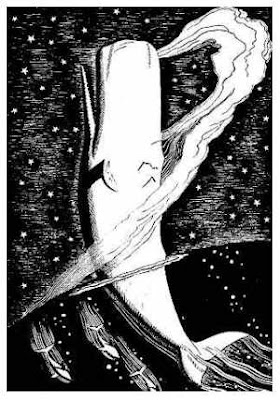
Of course, critics point out that, with any book of similar length, such "coded messages" can be found, if one knows what one is looking for and manipulates the data successfully. To prove this point, an Australian researcher "decoded" the text of Moby Dick and found prophecies of the assassination of Martin Luther King Jr., the death of Princess Diana, and more. According to him,  a certain group of believers countered his research with the claim that he had conclusively proven God to be the author of Moby Dick, not Herman Melville as was previously believed. Ahoy there, Jebus.
>
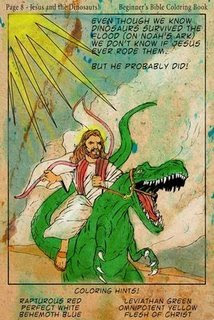
And this is the crux of the matter: that otherwise intelligent and educated people can believe such nonsense. The belief that the Earth is just over 5,000 years old - instead of the 4.5 billion that actual scientists tell us - is growing in popularity, as is the belief that the Creation Story in Genesis is factually accurate, and those pesky dinosaur bones that you and I can see and feel and touch were simply placed in the ground by God to test our faith. Another, related, belief about the dinosaurs, and one that I particularly find amusing, is that they were among the creatures Noah brought with him on the Ark. What happened to them after that is anybody's guess.


I understand faith, and I understand the need for a belief in something higher than oneself, especially in such currently troubling times, but why does faith need to equate with ignorance? Why, when faced with something we don't understand, do we instantly jump to the supernatural conclusion? I get it that rainbows are cool, but they're not miracles. A rainbow is an optical/meteorological phenomenon that occurs every single day. It's the refraction of light through droplets of moisture suspended in the atmosphere. There's no supernatural explanation necessary.

And as much as I appreciate that the birth of a baby is a landmark event in the lives of most people, that birth isn't a miracle, either. It's a repeatable event that occurs, non-stop, in every corner of the globe on every single day since mankind began. While it is significant, it is not a miracle.

An argument I've had frequently with believers in either Creationism or "Intelligent Design," is that their theories on the origins of Life, the Universe, and Everything, are just as valid as the Big Bang Theory, and the Theory of Evolution, as none of them can be conclusively proven or replicated in a laboratory, and none provide every last answer to every last question.

To them I say: Poppycock.

The difference between science-based explanations of the origins of Life, the Universe, and Everything, and faith-based beliefs, is that scientific theories have solid, evidential proof. Want evidence of evolution? Take a look at the development of the horse through fossil records. I can see and touch the bones of an Eohippus, and see the way the form of the animal developed over millions of years until it became the horse as we know it today. I don't have to rely on faith, and a book of mythology to tell me where the horse came from. Oh, but then there's that pesky assumption that God planted those bones to test our faith. Guess I fail that one.


The argument that any theory is as good and valid as any other theory is ridiculous on its face. Theories are more or less valid based on how much evidence supports them. And, I'm sorry, the Bible is no more evidence of the existence of God than Action Comics #1 is evidence of the existence of Superman. It would be lovely if it was otherwise, but just because you happen to believe in something doesn't make it real. My four- and six-year-old nieces firmly believe that Santa Claus slides down their chimney to deliver presents on Christmas Eve. Would that that were the case, but it's not, no matter how hard they believe in it. There is such a thing as objective reality.

So why do seemingly intelligent, educated people suddenly lose vast amounts of IQ points when confronted by things like the End of Days, the Bible Code, and Creationism? Why do so many people take these things seriously, or go so far as to espouse a literal interpretation of the Bible? Is it because our educational system has been steadily declining over the last several decades, failing to provide students with the critical reasoning skills necessary to confront these outdated superstitions? Or might it be that our understanding of science and scientific principles has reached such a high level that it is, to many laymen, indistinguishable from magic? I'll admit, the more I learn about quantum physics, the more it seems like sub-atomic hocus-pocus to me, but that's still no excuse for believing that dinosaur bones are here to somehow "test" us.

Perhaps it's that, in a day and age when many people feel like they are increasingly living at the whims and urges of others more powerful than themselves (i.e. the Government), the belief in a benevolent Higher Power is comforting. Perhaps ignorance really is bliss. But that only goes so far. Prohibiting people from marrying based on some outdated 2,000-year-old text, for example, is just wrong. Couching that prejudicial, ignorant belief in such flowery terms as "The Defense of Marriage Act," is, or should be, appalling and offensive to any rational, intelligent individual. Backing up your "opinion" on this type of societally-acceptable bigotry by saying, "Well, it's in the Bible so I believe it," is anti-intellectual drivel that should, in a perfect world, get you laughed out of the room. Without the ability to question and examine our beliefs, faith becomes mere dogma, and dogma, blindly applied, especially in social situations, is dangerous. That's a lesson that history has shown us time and time again, from the Crusades to the Salem Witch Trials to the Holocaust.


I wish I could propose a solution to this issue of willful ignorance, but I really can't. Especially so long as there are plenty of people with a vested interest in promoting that interest. How many copies of books having to do with the Bible Code, for example, have been written and sold? Enough to make someone, or multiple someones,  a very comfortable living, I suspect. How much money do churches around the world take in every day from the poor, dumb faithful, who are told that their tithes and offerings will assure them of a place at the Right Hand of God? These are the people and the institutions that foster this willful ignorance for their own gain. It's not a new phenomenon; it's been going on since the beginning of time.

Another factor in the growing reliance on superstition and mysticism is a lack of any sense of history. There's little, if anything, new under the sun, and a quick look at years past will confirm this. Currently, the best example of this is the incredible fascination with "End Times" literature, in which "prophets" from various disciplines tell us the world is about to end and/or God's judgment is about to be visited on the earth.

Many "seers" point to the year 2012 as the "End of Days," a fatuous belief made popular by the Mayan "Long Count" calendar, which seems to end on December 21st of that year. New Agers and other easily-deceived people have been wetting themselves for years over this "proof" that the world does not have long to live. They fail, however, to look below the surface of the calendar and see the real truth: that the Mayan calendar does not foretell the end of the world, just the end of a measured cycle. According to Meso-American scholars (i.e: those people that actually know something about this based on actual facts and research and not just hysterical rumor-mongering), the Mayans didn't see the end of the calendar as the end of the world. In fact, they celebrated the end of cycles, sort of the way we do on New Year's Eve. It's like getting all worked up because the calendar on your wall is about to expire. When I switched from a 2008 to a 2009 calendar, the world didn't end, it just marked the passing of a particular year. It's the same thing with the Mayan calendar. See how just a little bit of knowledge can set one's mind at ease? 

Others point to the Biblical Book of Revelations as "proof" that the world is about to end. In fact, Doomsday prophets have been pointing to this book as a prophecy of doom practically ever since it was written.

The Book of Revelations is, without a doubt, a gripping read, full of doom, destruction, and some of the greatest characters in Biblical literature, the Four Horsemen of the Apocalypse.


According to believers, the book is an account of a revelation given to "John" (there's a great deal of controversy as to whether this John, is, indeed, John the Baptist, John the Apostle, the author of the Gospel According to John, or simply someone else with the same first name. Let me tell you, it sucks to have such a common name) regarding the Second Coming of Christ and the ensuing cataclysmic battle between Good and Evil. If Stephen King was a Biblical prophet, this is the book he would have written.


Although the Book of Revelations is considered canonical, many leading thinkers and theologians have dismissed it entirely. Neither Martin Luther nor John Calvin had any use for it (Luther called it "an offensive piece of work"), and Thomas Jefferson omitted it entirely from the version of the Bible he edited, writing that he "considered it as merely the ravings of a maniac, no more worthy or capable of explanation than the incoherences of our own nightly dreams."

Some scholars note the growth of Amanita muscaria on the island of Patmos, John's home during the period in which he wrote Revelations.  A. musicaria is commonly known as fly agaric, a highly toxic and violently hallucinogenic species of mushroom. After ingesting a few of these, it would be no wonder that John saw visions.


And so, what is the significance of this oft-quoted book? As the Bush administration so deftly showed us, fear is a powerful tool when used to wield control over the masses. If the Church really wanted to control the actions and the thoughts of their followers, what better way then by instilling in them a healthy dose of fear regarding the imminent end of the world? Think of the Book of Revelations as the Biblical version of the Bush administration's Terror Alert system. Keep the people stupid and scared, and they'll follow you blindly, as long as you promise to keep them, and their immortal souls, safe.

Actually, Christian Doomsday beliefs predate John's exciting horror novel. Christians in the First Century firmly believed that Christ's return was imminent, as he told them he would be back shortly (predating both General Douglas MacArthur and Arnold Schwarzenneger). By about 90 AD, many of them realized that they had been had, and that maybe the end of the world wasn't coming quite so quickly after all. It would prove to be the first of many Apocalyptic disappointments throughout the ensuing years.

Martin Luther (1483-1546), he of the 95 Theses which marked the creation of the Protestant Church, was convinced that he was living in the end times. He said, "For my part, I am sure that the end is just around the corner... it is certain that time is now at an end." The Anabaptists - a radical Christian group formed during the Reformation -  were certain that the Millennium was to come in 1533. They didn't get the Apocalypse, but they did get Henry VIII's marriage to Anne Boleyn, and the establishment of the first mental institutions to make up for it. Of course, the year 1666 was one of great tribulation, marked, as it was, by the infamous Number of the Beast. I'm sure plenty of people saw Satan around every corner in that year, but the truth is, the biggest thing that happened in 1666 was either France and the Dutch declaring war on England, Antonio Stradivari labeling his first violin, the Great London Fire, or the first appearance of Cheddar cheese. Take your pick.



Than there's the Prophecy of the Popes, supposedly written by Saint Malachy in the 12th-century and revealed to the world in 1595 by Benedictine historian Arnold de Wyon. The document contains 112 short Latin phrases, supposedly describing each Pope in the order of his election, beginning with Pope Celestine II, who was named Pope in 1143, and ending with "Peter the Roman," the final Pope, whose reign will see the destruction of Rome and, presumably, the End of Days.

While it's an undeniably fun document, even the Catholic Encyclopedia considers it an elaborate forgery, couching their descriptions of later Popes in vague, almost riddle-like, terms., much like the celebrated prophecies of Nostradamus. For example, Pope John Paul II was described as "De labore Solis," or, "Of the Labor of the Sun." The term is sometimes interpreted as referring to a solar eclipse, so believers point to the fact that JP was born during a partial eclipse, or that as a young man he worked in a quarry (i.e.: "laboring in the sun"), or that the sun rises in the East, predicting that JP would be the first Pope from Eastern Europe, as proof of the accuracy of the Saint. Petrus Romanus, the final Pope, comes directly after Pope Benedict XVI, the current Pontiff, so be afraid... be very afraid.

And, of course, the list goes on and on. Christopher Love, a leading Presbyterian, predicted an earthquake that would shake the world in 1763, while Claas Epp, Jr., a minister in the Russian Mennonite faith, foretold Christ's return on March 8, 1889. When that day came and went, he revised his prediction to 1891. Keep trying , Claas.

Even more recently, the Prophets of the Apocalypse have been hard at work terrorizing people with visions of Hell on Earth. David Berg saw the coming of the Comet Kohoutek in 1973 as the harbinger of doom (he later changed his prediction to 1993), while televangelist Benny Hinn has foretold numerous dates for Christ's return, all of them passing without incident. William Kamm warned us about a devastating tidal wave that would sink the island of guam in 1994, while Harold Camping gave the hard date of September 6, 1994 as the Second Coming of Christ. Shelby Corbitt, working with information revealed to her by God himself, told us the Rapture - in which the faithful are bodily taken up to heaven, while the heathens are cast into the Lake of Eternal Fire - was coming in mid-2007. Are you seeing a pattern here?

One of my personal favorites is Gordon-Michael Scallion, a self-proclaimed "psychic" who has been predicting "earth changes" for decades, even going so far as to publish maps of future geography (now in its 3rd edition, according to his website) that will cost the faithful $30 a pop. It looks like Dallas is going to be beachfront property, so we're sitting pretty in North Texas. Of course, when Scallion's predictions don't pan out, he merely changes the date of his Doomsday scenario and continues to rake in the cash from book and map sales, seminars, etc. I guess if you're convinced the world is ending, it makes sense to make as much money as possible in the meantime. It's good to know, at least, that P.T. Barnum is alive and well.



And so it goes. This current round of Apocalyptic hand-wringing is nothing new. It bothers me, however, that we still haven't seen through this garbage, with all that we've advanced in the realms of science and technology. The Internet is ubiquitous these days; it takes very little effort to look up the facts on, say, the Mayan Calendar or the Bible Code, and see the flummery exposed for what it really is. Certainly, we've suffered through eight years of a President who seemed to make it his mission to stamp out learning and education in this country by any means necessary, but I'm disappointed that we, as a society, seem so eager to embrace his brand of willful ignorance.

There is, however, one thing we can all do to combat this dangerous scourge of anti-intellectualism, even in a day when having anything more than a Sixth Grade education gets you branded an "elitist": read. Read often and read a lot. Read anything and everything, especially viewpoints you disagree with. And always question what others tell you (even this). Don't believe it just because someone says it. Find out for yourself, and don't be afraid to crack a book open.

You might be surprised by what you learn.


Saturday, January 3, 2009

Comic Review: X-Men #500-504

Writers: Matt Faction and Ed Brubaker
Artisits: Greg Land, Jay Leisten, Terry Dodson, Rachel Dodson

If memory serves me right, the first X-Men comic I ever read was issue #36 (September 1967), in which Xavier's young students - at that time, back in the Dark Ages, Cyclops, Angel, Marvel Girl, Iceman, and the Beast - battled Mekano, a disgruntled college student with a strength-enhancing exoskeleton.


After that, I followed the adventures of Marvel's Merry Mutants sporadically, getting on board for good with the publication, in the Summer of 1975, of Giant-Sized X-Men #1, the book that single handedly reinvented Marvel. I was a loyal fan for years, enjoying the tales woven by Chris Claremont, Dave Cockrum, John Byrne, Paul Smith and others, but eventually the franchise started to collapse under its own weight. Where there had once been only a handful of mutants, now there were literally thousands. It seemed that, in the Marvel Universe, every other person you passed on the street was a mutant. It got to the point that mutants eventually had their own country, Genosha. It was impossible to keep track of all the characters coming and going, and I eventually lost interest and dropped the main title and all its spinoffs somewhere around issue #400.

Apparently, Marvel also felt that this was a problem, as they attempted to rectify the issue in their mega-event, Avengers Disassembled, when Wanda Maximoff, aka the Scarlet Witch, obliterated virtually all mutants from the Marvel landscape with three little words cast as a reality-altering spell: "No more mutants."

All of a sudden, the vast population of mutant humanity was reduced to a relative handful. Perhaps now it would be possible to make sense of what was going on and who was who. At least after Marvel got the rest of their ultra-mega reality-altering events out of their system.

Well, now it's post-Avenges Disassembled, post-House of M, post-Civil War, and post-Secret Invasion, and, lo and behold, X-Men has hit issue #500. Traditionally, important issues like this are considered good jumping on points, so I thought I'd give Marvel's mutants another chance, even though I expected to be disappointed and confused.


What can I say, I was pleasantly surprised. Behind a beautiful cover by Alex Ross, writers Ed Brubaker and Matt Fraction set to work establishing a new status quo for the X-Men, relocating them to San Francisco in the wake of the destruction of Xavier's mansion, their traditional home, in Westchester, NY.  Although there are a few plot points that go unexplained for new readers - like, why is there a Celestial standing in the middle of Golden Gate park? - overall this is, as hoped, a good place either to climb on board for the first time or to get re-acquainted with the franchise. Over the course of the next few issues, Brubaker and Fraction tell the story of a mutant named Empath who, under the control of the mysterious and enigmatic Red Queen, leads an anti-mutant hate group, beating up all the mutants who have now come to SF to join the X-Men. At the same time, Magneto - depowered in the wake of Wanda's spell - joins forces with the mysterious High Evolutionary for reasons that have yet to be revealed, and battles the X-Men, his powers seemingly restored. It's a good read, told briskly over the course of four issues. I give them credit for not padding it out to six issues as seems to be industry standard these days.

Fraction and Brubaker are two of the better writers working in comics today. Brubaker, of course, is the guy who did the seemingly impossible: he brought Bucky, Captain America's World War II-era partner whose death shaped much of Cap's character over the last forty years, in a way that didn't seem trite, forced, or ridiculous. And Fraction is the new writer on Iron Man, a book that, sadly, has floundered under a lack of creative direction for years. I have high hopes that he'll make the character worth reading again.

While the story is a good read, the art in #500-503 is less successful. Greg Land is a proponent of the photo referencing school of comic book art, in which he uses photos of real people as the basis for his drawings. This leads to a number of problems. First, virtually all of Land's people look the same, distinguished only by their costumes and hair color. Face and body structure are identical from figure to figure. Second, Land's poses are stiff and static, like his characters are posing for a product advertisement (no doubt many of them were). It's difficult to get involved with characters when they all look like they're posing for a Pepsodent ad, especially when they express emotions wholly inappropriate to the moment. Yes, Photoshop is a good thing, but it's being overused in comics today, especially in the work of artists like Land.

Things get better in issue #504, when the husband and wife team of Terry and Rachel Dodson take over the art chores. They have a far more pleasing style than Land, less stiff and photo referenced. They're particularly adept at rendering beautiful women, which this issue definitely spotlights. With any luck, they're on the book for the long haul.

Another thing to like about the current status quo of the team is the use of long-established characters. For quite a while, it seemed, the X-Men were populated entirely by second stringers. Now, Cyclops is in charge as team leader with Emma Frost as his second. Also on the team are the Angel and the Beast - both founding members - Colossus, Storm, Nightcrawler, and Wolverine (the most overexposed character in the history of comics. Are we really supposed to believe that Logan can be a functioning member of this West Coast-based team while, at the same time, serving as part of the East Coast-based Avengers. Come on.), with intriguing newer characters like Pixie thrown in for good measure. The use of these long-established characters restores a sense of history to the team, and brings them back to the forefront of the Marvel Universe, as one of the premiere super teams.

All in all, it's a good effort that make the X-Men more accessible than they've been in years. My hat's off to Fraction and Brubaker for putting this once-mighty book back on track.

Rating: Three Ravens (Land issues), Four Ravens (Dodson issue) out of Five.

Friday, January 2, 2009

What Censorship Is... And Is Not


Over on my friend Keith's blog, he talks about a discussion we had on New Years Eve about blogging. I told him that I had just started doing this, and the question about what to or what not to blog about came up. I feel strongly that, in this day and age of technological sophistication, when these blog posts are available to anyone with an Internet connection, one has to be extremely careful and thoughtful in what one posts, especially when one is in the position, as Keith and I both are, of looking for a job. What we write, once posted, becomes public content, not easily eradicated, for which the consequences can be potentially severe.


For that reason, I'm likely to shy away from talking about issues and disagreements I've had with past employers. First of all, that's really nobody's business, and secondly, that would probably be looked on with disfavor by a future potential employer. Certainly, I've had my share of disagreements and resentments with people I've worked for in the past - everyone has - but I don't really see a value in flaunting those here in a public forum. Yes, there is value in "getting it off my chest," but that's what friends and family are for. I can, and sometimes do, spend whole evenings bitching about this and that to Judy or Keith or any number of people, but that's private and not a subject of public discussion.


So far, after reading his post, I think Keith would agree with most of what I've said. But then he goes on the say,


"So I have a quandary… since my blog is part of my personal site that includes my resume and my portfolio, do I start censoring what I do and do not comment on? Do I maintain the level of transparency I’ve grown accustomed to in the name of intellectual honesty and risk losing future jobs? Do I keep up the honesty, but move the blog to a different, more anonymous outlet, impugning the intellectual honesty but lessening the degree I cut off my own nose to spite my face ’cause I can’t keep my damn mouth shut? For anyone else, these would probably be easy questions, but for a guy who refused a needed Christmas bonus and declined a wanted job interview to avoid compromising his admittedly too-frigging-rigid ethics, not so much (look up the definition of “Pyrrhic” in the dictionary sometime, you’ll see my picture).


This is the part that I really disagree with. Let's start with the line, "...do I start censoring what I do and do not comment on?" Maybe Keith just chose the wrong word, but censorship isn't the issue here. The Oxford English Dictionary - the best language resource on the planet, bar none - offers the first definition of the word "censor" as:


"An official who examines material that is to be published and suppresses parts considered offensive or a threat to security."


The first two words there are key. "An official" refers to an outside agency that reviews a work and decides whether or not it can be presented to the public. It's done without the original author's participation or consent. It's typically a bad thing, flying in the face of one of our most basic human rights, the right to the free expression of ideas.


However, the word has no application here, as there is no outside agency trying to "censor" Keith's blog. What he's talking about is part and parcel of the process of creation: deciding what goes into the finished work and what doesn't. Artists and writers do this all the time, with varying degrees of success. Every book ever written has gone through an editing process, for example, in which parts of it are trimmed, either to improve the pace of the story, to make the book more marketable, to increase comprehension, or whatever. This isn't censorship, even if it's done by an editor that is not the author. That is the editor's job. It's also not censorship when a publishing house declines to publish the novel that you've worked so hard on. That's a business making a business decision that they have every right to make.


Frankly, the word censorship - an incredibly loaded and potentially divisive word - is thrown around far too freely in this age of "inalienable rights." No rights are absolute, and that includes the freedom of speech. Yes, you can express yourself, but then you have to deal with the consequences of that expression. Libel and slander laws are just two ways in which we limit the scope of free speech. That, too, is not censorship, it's responsibility.


So what is censorship? Suppose the New York Times was about to break a story on the political abuses of an extremely unpopular and corrupt vice-president, a story that could very well lead to criminal charges against said public figure. If the White House were to put pressure on the NYT to prevent them from running the story, that would be censorship. It was precisely to avoid this kind of thing that the venerable Founding Fathers included "Freedom of the Press" in the Bill of Rights, as this kind of behavior was far too common under the monarchical system they were trying to get away from. It's a right that has served us well, no doubt, but it has to be used responsibly.


Perhaps Keith would prefer the word "filtering," as in "... do I start filtering what I do and do not comment on?" Actually, he already does, as he decides what to write about and what to leave out. I have yet to see a description of his daily breakfast on his blog, or a moment-by-moment account of his drive from Mesquite to Lewisville. Forget the fact that these are mundane activities, he's already deciding what to and what not to write about, therefore he is already self-filtering. He's not censoring himself by deciding not to write about these things, he's engaging in a constructive process of creative filtration.


He then says:


"...Do I maintain the level of transparency I’ve grown accustomed to in the name of intellectual honesty and risk losing future jobs?"


"Transparency?" "Intellectual honesty?" These are both fine qualities that we expect in our public officials, but what do they have to do with blogging? There's no real requirement for either in a blog, as the only person you're responsible to is yourself. As much as bloggers don't want to hear this, the vast majority - and I mean 99.999% of people writing blogs out there - are not journalists in any way, shape, or form. They may be diarists - and there's nothing wrong with that - but they are not journalists. I mention this because journalists - those who research and report on news - are held to  a higher level of transparency and intellectual honesty. That's not the case in blogging. Unless you're paid by someone to blog on a particular subject, you are under no obligation to be honest or transparent. I could, if I wanted to, blog all about my recent trip to Antarctica, where I climbed Mount Kilimanjaro and shot an elephant in my pajamas. Not only would it be a lie and  intellectually dishonest, but I'm under no obligation to tell you it's a lie, thus eliminating the requirement for transparency. And guess what: nothing would happen. The Blog Police wouldn't knock down my door at 3 a.m., Judy wouldn't leave me, my friends wouldn't shun me... nothing. This blog is exactly what I wnat it to be, nothing more. You, as the reader, have no rights here. I will tell you what I want, when I want, in whatever way I want, and you will either read it or not.


And that's the crux of the matter: a blog is about what the writer wants it to be about. If you want to post the details of every conversation, every real or imagined slight, every disagreement, every argument, go ahead. But then, when you're asked the unanswerable question, such as "Does this make me look fat?," you'd best not filter your thoughts or compromise your intellectual honesty and give a true, honest answer.


And suffer the consequences.


Thursday, January 1, 2009

The Beginning of a New Year

So 2009 is here at last. Personally, I thought 2008 would never end. That sure was one for the books.

I know lots of people are posting New Years Resolutions these days, but I hate those, as they're doomed to failure. Instead, I'd offer this outstanding video from Ryan Shupe and the Rubber Band, which seems to me to be just about the best possible way to approach the coming year. It's called "Dream Big," and it's a great song to take to heart, especially in these troubled times. We've all lost so much, whether you measure that loss in dollars and sense, hope, jobs, lifestyle, or whatever, and often our dreams are the only things we have left. Shupe expresses thise perfectly.

I've just discovered this band, and I really think they're great. Another song that's a personal favorite is "Even Superman," a really touching tune.

So here's wishing everyone a healthy, happy and prosperous 2009. After the last few years, we deserve it.


Wednesday, December 31, 2008

I Join the iPhone Revolution


I'll admit I'm something of a gadget freak. I love new technology and can't wait to get the latest cool gizmo. I adopted VHS early on, and started building a home video library back in the days when VHS tapes were relatively new and most were priced at the ridiculous sum of $89.99. Still, having the ability to watch such classics as RAIDERS OF THE LOST ARK or ROBOT MONSTER at any time, day or night, was worth the price of admission.

I got a CD player when those were fairly new, when record stores still sold, you know, records, and when CDs made up a miniscule portion of their inventory. Once again, the chance to be in the forefront of a technological revolution was pretty great.

And now we come to this, Apple's iPhone 3G. I resisted getting the first, and even the second iteration of this groundbreaking device, knowing that they would be plagued with bugs. And apparently I was right. There were a number of problems with those earlier versions. But Apple has apparently worked hard to resolve them, and, while I'm sure that this latest version will have its issues as well, it's a pretty slick device.

For all intents and purposes, this is like having a computer in the palm of your hand. It handles email, plays movies and video, accesses the Internet via the Safari web browser, and does virtually everything your home desktop does. The only things that I can see that it lacks so far are basic word processing and spread sheet programs, and I wouldn't be surprised to see those in the somewhat near future.

The best part about the iPhone are the applications, or "apps" that one can download and install. Although many of the apps are for sale, there are a number that are free, and I've been downloading those like crazy. Some of my favorites:

  1. Lightsaber: This one puts a lightsaber on your screen, complete with music. When you move the iPhone, it makes cool lightsaber noises. Just about the closest you can come to actually being a Jedi.
  2. Shazam: Whoever came up with this should be burned at the stake as a witch. I mean, this is just this side of black magic, and just as cool. Run Shazam, hold you iPhone up to any music source, and it will listen to the song, analyze it, then identify the song and tell you where you can buy it. It's not infallible - it failed to identify some Celtic music I heard on the radio - but it's pretty damn good. I'm in awe of the people who developed this incredible app.
  3. Yelp: Using the 3G's built in GPS capabilities, the iPhone can find a variety of businesses, including restaurants, bookstores, drugstores, banks, and much more, all located within a defined area around your current position. I can't imagine how helpful this is going to be.
  4. Flixster: Being able to watch movie trailers in the palm of your hand is what technology is all about.
  5. Mobile News: Instant headlines from the world's top news feeds.
  6. iSushi: Again, using GPS coordinates, my iPhone can now tell me where the nearest sushi restaurant is located. Yum.
  7. Pumpkin: Incredibly dopey, this app let's one create a scary pumpkin face, complete with flickering candle light and spooky sound effects.
That's just a few of the cool apps I've downloaded, and I'm sure there will be more to come. It seems that new things are being created and posted everyday.

And now, it's time to stop blogging and go back to playing with my iPhone.


Monday, December 29, 2008

Me and Stan the Man


From time to time, I'll post some of my favorite pictures, and I can't think of a better one to start with than this.

That's a picture of me with Stan "The Man" Lee. For the tragically unhip, Stan was the writer and co-creator of such pop culture icons as the Fantastic Four, the Hulk, Iron Man, the X-Men, Spider-Man, and much, much more. When I was a kid - a kid who was deeply into comics - I idolized Stan. Even more than the artists - legends like Jack Kirby, Steve Ditko, John Romita, Gene Colan, and George Tuska - Stan was, to me, the heart and soul of Marvel. He was the one who created the "clubhouse" feel that made Marvel seem like more than a big corporation (like rival DC), but like a bunch of friends who loved comics as much as I did. Stan wrote virtually every title Marvel published in the early years, and, even in the books he didn't write, his presence was felt through the "Bullpen Bulletins Page," and his monthly "Stan's Soapbox."

What made Stan so different from virtually everyone else writing comics at the time was that he wrote stories that both adults and kids could enjoy. He wasn't writing pretentious "graphic novels," like so many "creators" seem to be doing today, nor did he write down to his audience, assuming they were semi-literate morons, as many writers - then and now - tend to do. No, Stan knew how to write engaging, fast-paced stories that would stand the test of time. Don't believe me? Then check out such personal favorites as CAPTAIN AMERICA #106 ("Cap Goes WILD!!"), FANTASTIC FOUR #48-50 (the justly famous "Galactus Trilogy") or JOURNEY INTO MYSTERY #114-115 (the introduction of the Absorbing Man in Thor). These are just a few examples of the way Stan could write a story that could be enjoyed on a number of levels, and illustrate just why I think he's one of the greatest writers of the modern era.

Anyway, when I joined Heritage Auction Galleries as their founding director of Rare Comic Book and Comic Art Auctions, I soon had the chance to meet and work with Stan to sell his collection. While not a collector himself, Stan had amassed a treasure trove over the years (or so we assumed: even Stan admitted in our preliminary talks that he had no idea what he might have), so the decision was made that I would fly to Los Angeles and inventory his stuff.

If you're into comics at all, you know what a thrill this was. Not only was I going to meet one of my lifelong idols, but I was going to get a chance to dig through his closets! After the initial shock wore off, I started to have second thoughts, though. What if Stan wasn't the kind of guy I imagined him to be? What if he was a nasty, bitter, cynical old man who just wanted to cash in on past glories? If that was the case, I knew that nearly forty years of adulation and hero-worship would go down the drain (on a much smaller scale, I had had a similar experience with Frank Perdue some years earlier. In his chicken commercials, Perdue always seemed like a decent guy, and so when I heard he was doing a local store appearance, I made sure to stop in. I can't imagine a meaner, less friendly person.  I know that everyone has a bad day once in a while, but he really went above and beyond. What a jerk.)

And so I flew out to meet Stan. Bear in mind that this was right around the time that the first SPIDER-MAN movie was coming out, so Stan was incredibly busy doing interviews and personal appearances, with enough stress to test the mettle of a man half his age. I was, to say the least, nervous.

And then I met him. He came into the room where I was working and gave me a warm handshake, introduced himself (as if I wouldn't know who he was), and apologized for not being more accessible. And then he invited me to go to lunch with him. Best of all, he even bought my lunch. Stan "The Man" bought me lunch!

Stan turned out to be the nicest, friendliest, most down-to-earth guy you could possibly imagine. As much as he comes across bigger than life in his TV appearances, he couldn't have been more genuine in the time I got to spend with him. On a subsequent trip, he invited me to his home, where I met his utterly charming wife Joan. Honestly, they don't get much better than Stan.

The photo above was taken in his office during a later trip, when I presented him with the first check for the sale of his comics and memorabilia. In the storage area, in the midst of everything, I managed to find a near-complete collection of important Marvel first issues, including FANTASTIC FOUR #1, AMAZING FANTASY #15, INCREDIBLE HULK #1, TALES OF SUSPENSE #39, and many more. Working with Steve Borock at CGC, we were able to encapsulate and label the books as coming from the "Stan Lee Collection," and they sold for astronomical prices when offered. The auction itself was a thrill, but meeting and getting to spend time with Stan was really one of the high points of my life.

So that's the story behind the picture. It hung on my mother's refrigerator for years, and now it's here. Enjoy.